Are you paying top dollar for the "strongest magnet in the world," only to watch your product fail in the field? Buying premium magnets without understanding their physical boundaries destroys your profit margins and damages your brand reputation.
Quick answer: Among permanent magnets, Neodymium-Iron-Boron (NdFeB or Nd2Fe14B)1 is the undisputed "king of magnets" because it delivers the highest maximum energy product (BHmax ≈ 30–55 MGOe). However, in laboratories, the absolute strongest magnetic fields come from superconducting electromagnets, not permanent magnets.
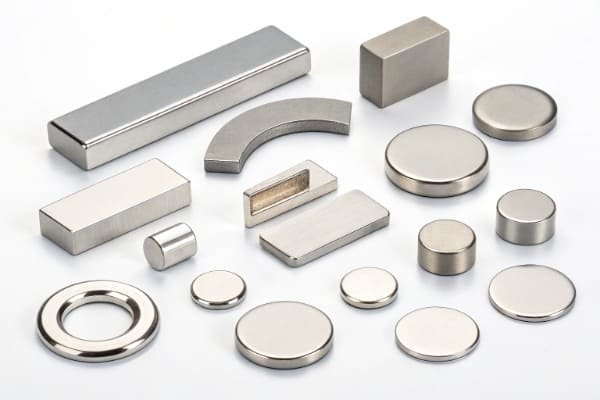
I see procurement managers and engineers make this mistake every single day. They look at a datasheet, see NdFeB labeled as the "king," and assume its sheer power will solve all their design problems. But in the real world of manufacturing, power is nothing without stability.
Let us break down the engineering facts behind the king of magnets, how it compares to other materials, and most importantly, when you should absolutely avoid using it.
Why NdFeB Earned the Crown (The Engineering Truth)
If you are designing a high-performance EV motor2, a microscopic smartphone speaker, or a premium magnetic wireless charger, space is your biggest enemy. You need maximum power in a minimal footprint. This is exactly why NdFeB dominates the market.
The "strength" of a permanent magnet is measured by its Maximum Energy Product (BHmax)3. This metric tells you how much magnetic energy is packed into a specific volume. NdFeB significantly outperforms every other permanent magnet material in existence.
Permanent Magnet Material Comparison
| Material | Max Energy Product (BHmax) | Coercivity (Hcj) | Max Operating Temp | Cost Level |
|---|---|---|---|---|
| NdFeB (The King) | 30 – 55 MGOe | High to Very High | 80°C – 230°C | Medium-High |
| Samarium Cobalt (SmCo)4 | 15 – 32 MGOe | Extremely High | 250°C – 350°C | High |
| Alnico | 5 – 10 MGOe | Low | Up to 500°C | Medium |
| Ferrite (Ceramic) | 1 – 5 MGOe | Medium | Up to 250°C | Low |
While Ferrite is cheap, using it means your product will be massive and heavy. NdFeB allows for extreme miniaturization. That is the true value of the "king."
The "Air Gap" Trap: Why Your King Feels Weak
"I bought an N52 magnet5, but it can barely hold my cabinet door closed!" I hear this complaint constantly.
A magnet's grade is only its potential energy. In real-world applications, your actual pull force is dictated by the magnet's volume, the thickness of the steel it is attaching to, and the most brutal enemy of magnetic force: the air gap (Luftspalt)6.
An air gap is any non-magnetic material sitting between the magnet and the target metal. This includes plastic housings, double-sided tape, paint, and even the anti-corrosion coating on the magnet itself.
Even a 0.5mm air gap can slash your pull force by over 50%. Furthermore, if the steel plate you are attracting is too thin, it will become magnetically "saturated," and the extra power of your NdFeB magnet will simply be wasted. Before you blame the magnet, check your assembly tolerances.
The Limits of the King: When NOT to Use NdFeB
The king is incredibly powerful, but it has fatal weaknesses. If you ignore these environmental factors, your product will fail catastrophically.
1. High-Temperature Demagnetization
Standard NdFeB magnets (like a basic N52) will permanently lose their strength if they exceed 80°C. If your application runs hot, you must specify a high-temperature grade suffix7.
- Use H, SH, UH, or EH grades to increase the Intrinsic Coercivity (Hcj) and survive temperatures from 120°C up to 200°C.
- If your environment consistently exceeds 200°C, you must dethrone the king and use Samarium Cobalt (SmCo) instead.
2. Severe Corrosion
NdFeB contains iron. If you leave it exposed to moisture, sweat, or salt spray, it will rust, expand, and turn into powder. You must specify a robust coating. For standard electronics, Ni-Cu-Ni is fine. For marine or outdoor environments, specify heavy-duty Epoxy or Parylene coatings8.
3. Mechanical Shock
Sintered NdFeB is not solid metal; it is manufactured via powder metallurgy. It is as brittle as a ceramic coffee mug. If you let two powerful magnets snap together across a table, they will shatter into sharp pieces. Always design protective housings or use non-magnetic spacers during assembly.
The N52 vs. N55 Dilemma: Stop Wasting Money
Many buyers desperately search for N55 magnets, thinking they need the absolute "strongest magnet you can buy." This is often a huge waste of procurement budget.
Yes, N55 has a higher BHmax than N52. However, the actual performance increase is only about 5% to 6%. Meanwhile, N55 is significantly more expensive, harder to mass-produce consistently, and highly sensitive to temperature.
Engineering Insight: Do not over-engineer the grade. If you need 10% more pull force, simply increasing the thickness of an N48 or N52 magnet by 1mm is almost always cheaper, more stable, and easier to source than forcing an N55 into your design. Size and geometry trump the grade number every time.
The Ultimate Magnet Selection Checklist
Stop guessing and start engineering. Use this checklist before you issue your next purchase order:
- [ ] Space & Force: What are my strict dimensional limits and target pull force?
- [ ] Thermal Margin: What is the absolute peak temperature of my device? (Always build in a 20°C safety margin when selecting the grade suffix).
- [ ] Environment: Will it face humidity, salt, or chemicals? (Determine if you need NiCuNi, Epoxy, or Parylene).
- [ ] Assembly: How will my factory workers handle these safely without shattering them? Do I need magnetic shielding packaging9 for air freight?
Frequently Asked Questions (FAQs)
What is the king of magnets—permanent vs overall strongest? NdFeB (neodymium) is the king of permanent magnets. However, the absolute strongest magnetic fields overall are generated by superconducting electromagnets in research laboratories, which require massive amounts of electricity and liquid helium cooling.
Are N52 magnets the strongest commercially available? N52 is the strongest widely and consistently available commercial grade. While N54 and N55 exist, they are restricted by extreme temperature limitations and higher costs, making N52 the practical ceiling for most mass-market engineering designs.
Why does my "king" magnet feel weak? Your magnet feels weak because of an air gap (plastic, paint, or tape between the magnet and the metal), or because the steel target you are trying to stick to is too thin and has reached magnetic saturation10.
Work With a Reliable Manufacturing Partner
At MagniPro, we do not just sell you a piece of metal. We help you navigate the complex engineering trade-offs11 between grade, temperature, coating, and cost to ensure your product succeeds.
With our ISO 9001 and IATF 1694912 compliant quality systems, full functional testing (including thermal shock and salt spray), and global delivery capabilities, we eliminate your sourcing risks.
Submit your dimensions, temperature requirements, and target pull force today. Our engineering team will provide a customized, cost-effective solution within 24 hours.
Explore the unique properties of NdFeB magnets to understand why they are considered the strongest permanent magnets. ↩
Discover the ideal magnet types for EV motors to enhance performance and efficiency. ↩
Learn about BHmax and how it affects the performance of different types of magnets. ↩
Find out why SmCo magnets are a great alternative in high-temperature applications. ↩
Get insights into N52 magnets, their strength, and where they are best utilized. ↩
Understand the impact of air gaps on magnet strength to improve your designs. ↩
Learn about the different grade suffixes that enhance magnet performance in high temperatures. ↩
Explore various coatings to protect magnets from corrosion and environmental damage. ↩
Discover the importance of magnetic shielding in safe transport and handling of magnets. ↩
Learn about magnetic saturation and how it affects the performance of magnets in applications. ↩
Explore the critical trade-offs in magnet selection to optimize your engineering designs. ↩
Understand the significance of these certifications in ensuring quality in manufacturing. ↩