Frustrated with magnets that fail under heat? You chose a high-grade magnet, yet performance drops, leading to costly warranty claims and damaging your reputation.
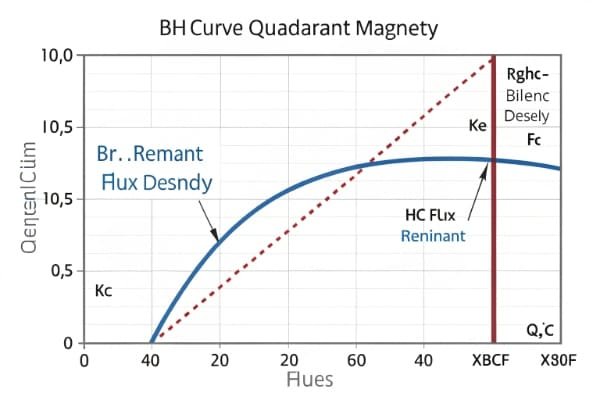
The BH curve1 is your most critical engineering tool for predicting a magnet's real-world performance, but most people only look at a fraction of it. For permanent magnets2, the secret to reliability lies in the second quadrant, which shows how the magnet behaves under actual load and temperature.
Many engineers I talk to treat the BH curve like a simple spec sheet, glancing at one or two numbers. They pick the magnet with the highest strength and call it a day. I've seen this approach lead to disaster more times than I can count. A client once came to me after their new motor design kept failing in thermal tests. They had chosen a powerful N52 magnet, but they hadn't understood how its performance would collapse at the motor's operating temperature. This is a common and expensive mistake. The good news is, learning to read the BH curve correctly is the key to preventing it. This isn't just about academic theory; it's about making practical, reliable engineering decisions3 that protect your product and your bottom line. Let's dive into how you can use this tool like an expert.
What Does the BH Curve Really Tell Engineers?
Tired of textbook definitions that don't help with your actual design? You see terms like Br, Hc, and (BH)max4, but they feel disconnected from your application.
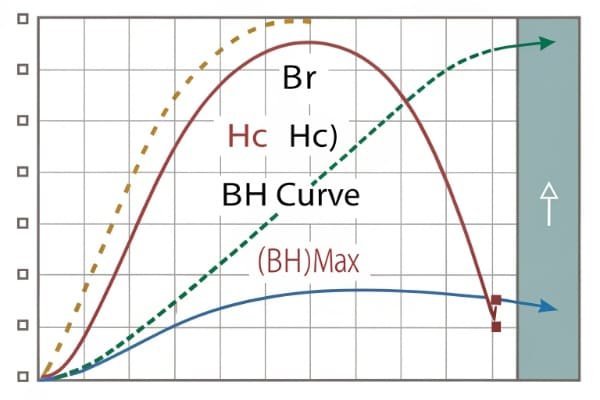
The BH curve reveals a magnet's core personality: Remanence (Br)%%%FOOTNOTE_REF5%%% is its maximum strength, [Coercivity (Hc)](https://en.wikipedia.org/wiki/Ferrite(magnet))6 is its resistance to demagnetization from external fields, and Intrinsic Coercivity (Hcj)7 is its resistance to demagnetization from heat and internal stress. (BH)max represents its peak energy output.
Let's break this down in a way that actually helps you. Think of a magnet like a slingshot.
- Remanence (Br)5: This is how far back you can pull the slingshot. A higher Br means a "stronger" magnet in a perfect, closed circuit, capable of producing more magnetic flux.
- Coercivity (Hc)6: This is like the force of wind blowing against your slingshot. It represents how well the magnet resists being demagnetized by an opposing magnetic field.
- Intrinsic Coercivity (Hcj)7: This is the true measure of the slingshot's rubber band quality. It tells you how much heat or stress the magnet can take before it permanently loses its strength—like the rubber band becoming brittle and snapping. For motor or high-heat applications, Hcj is often the most important parameter.
- (BH)max: This is the "sweet spot" where the slingshot delivers the most powerful shot. It's the point of maximum energy product. However, designing for (BH)max alone is a rookie mistake; your magnet almost never operates at this exact point in a real application.
| Parameter | What it Represents | Analogy | Key Takeaway for Engineers |
|---|---|---|---|
| Br | Maximum Magnetic Flux | How far a slingshot pulls back | A measure of potential strength, but not real-world performance. |
| Hc | Resistance to External Fields | Wind blowing against the slingshot | Important for applications with opposing magnetic fields. |
| Hcj | Resistance to Irreversible Demagnetization | The rubber band's durability against heat/stress | Crucial for thermal stability8 and high-stress environments. |
| (BH)max | Maximum Energy Product | The slingshot's point of maximum power | A theoretical peak, not a practical design point. |
How Do You Avoid Catastrophe by Mastering the Demagnetization Curve?
Are you worried about your magnet suddenly losing power when it gets hot? This "silent killer" of performance can be predicted and prevented by looking at the right part of the curve.
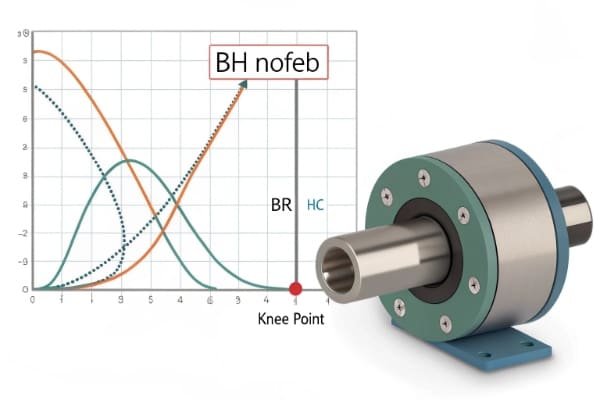
Focus on the second quadrant, also known as the demagnetization curve%%%FOOTNOTE_REF9%%%. Your magnet's real-world performance is determined by the [Operating Point](https://en.wikipedia.org/wiki/Saturation(magnetic))10, which is where its Load Line (Pc)11 intersects the curve. If that point falls below the "knee" of the curve, the magnet will suffer permanent, irreversible strength loss.
This sounds technical, but the concept is simple and vital for any engineer. Let’s make it practical. For permanent magnets2, we only care about the second quadrant because it shows how the magnet behaves when it's doing work in your product.
The Load Line (Pc)11 is Your Application's Fingerprint
The Load Line, or Permeance Coefficient (Pc), is a straight line whose slope is determined by the magnet's shape and its magnetic circuit12.
- Thin, flat magnets (like a coin) have a low Pc. Their operating point is lower on the curve, closer to danger.
- Tall, thick magnets (like a rod) have a high Pc. Their operating point is higher and safer.
- Adding steel parts to a magnetic circuit (like a backing plate) effectively increases the Pc, making the magnet more efficient and resistant to demagnetization.
The Operating Point10 & Knee Point Risk
Your magnet's true performance is at the Operating Point, where the Load Line intersects the BH curve. The danger zone is the "knee"—the point where the curve is no longer a straight line. If your operating point falls below this knee due to heat or an external field, the magnet is permanently damaged.
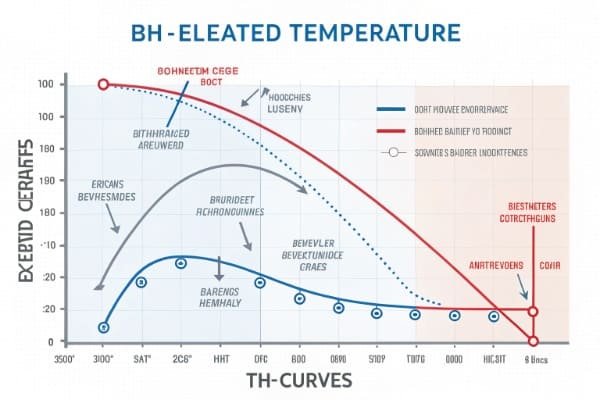
The real challenge? Temperature changes everything. As a magnet gets hotter, the knee moves up and to the left. A design that is perfectly safe at 20°C can become a catastrophic failure at 120°C because the knee has shifted above its operating point. This is why high-temperature demagnetization13 is the silent killer of motor performance.
How Do Real-World Applications Change How You Read a BH Curve?
Do you think a magnet is just a magnet? Using the same selection criteria for a high-speed motor and a wireless charger is a recipe for failure or over-engineering.
No, every application imposes a unique load and environment. Motors demand extreme thermal stability8 (high Hcj), while wireless chargers require precise field uniformity and tolerance control. You must read the BH curve through the lens of your specific application's demands.

A catalog value is just a starting point. Real engineering happens when you match the magnet's properties to the application's stress factors. I always ask my clients to describe the operating environment in detail, because it completely changes how we should interpret the BH curve.
For Electric Motors
In motors, efficiency and reliability are paramount. High-temperature demagnetization is the single biggest risk.
- Focus on Hcj First: Motor magnets operate at high temperatures and face strong demagnetizing fields from the stator windings. Therefore, magnetic stability is more important than peak flux density. You need a grade with a high Intrinsic Coercivity (Hcj)7 that provides a sufficient temperature margin. A lower-strength but higher-temp grade (like N45SH) is often far superior to a standard N52.
- Rotor Design Matters: The shape of the magnets and the steel components in the rotor determine the Load Line (Pc)11. A well-designed rotor has a high Pc, pushing the operating point higher on the curve and making the system more robust against heat.
- Consistency is Key: A motor's smooth operation depends on the consistency of all magnets in the rotor. A reliable supplier provides magnets with tight tolerance control, not just good average values.
For Wireless Charging
Here, the goal isn't raw power, but efficient and stable energy transfer.
- Alignment and Uniformity: Performance depends more on the precise alignment and uniformity of the magnetic field than on raw power input. Small dimensional deviations in the magnet can cause large losses in charging efficiency.
- Balancing Act: Wireless charging magnets must balance magnetic force, overall thickness (for sleek product design), and assembly tolerances. A slightly weaker but more uniform or thinner magnet might be the better choice. The BH curve helps model these trade-offs.
How Can You Use the BH Curve for Smarter Magnet Selection?
Stuck choosing between two different magnet grades14? The datasheet numbers look similar, but you know the real-world performance will be different, especially under stress.
Use the BH curve as a simulation tool. Plot your application's Load Line (Pc)11 on the BH curves of different grades at your maximum operating temperature. The grade that keeps its operating point safely above the knee and delivers the required flux is the right choice.
 This is where theory becomes a powerful, practical tool for saving money and preventing failures. Let's walk through a common scenario.
A client needed a magnet for a sensor that would operate at 120°C. They were deciding between N52, our strongest grade at room temperature, and N45SH, a high-temperature grade.
Comparing Grades at Operating Temperature
- At 20°C: The N52 magnet has a higher Remanence (Br)5 and looks much stronger on paper. Its (BH)max is significantly higher.
- At 120°C: The story changes completely.
- The N52 curve's "knee" moves drastically up and to the left. Its ability to resist demagnetization plummets.
- The N45SH curve, thanks to its much higher Intrinsic Coercivity (Hcj)7, remains a straight line in the working quadrant. It is far more stable.
For their specific design (a low Pc value), the N52 magnet's operating point fell below the knee at 120°C, causing irreversible losses. The N45SH, while weaker at room temperature, performed reliably and predictably at the target temperature. By choosing the N45SH, they avoided a product recall.
When to Demand Supplier-Level Data
The BH curves you see in catalogs are just typical values. The performance of magnets from different production batches can vary. For any critical application, especially involving heat, you must ask your supplier for the BH curve data specific to the batch you are purchasing. A reliable supplier will have this data and be able to help you analyze it for your application. This focus on repeatability is what separates a true partner from a simple trader.
Conclusion
Stop designing with datasheet headlines. By focusing on the second quadrant, your load line, and temperature effects, you can use the BH curve to ensure your product's long-term reliability.
Talk to a Magnet Engineer
If you're facing a design challenge or want to ensure you're selecting the most reliable and cost-effective magnet, let's talk. I can help you analyze the BH curve for your specific application and avoid costly mistakes. Submit your requirements—application, dimensions, temperature, and quantity—and my team and I will provide a technical recommendation within 24 hours.
Understanding the BH curve is essential for predicting magnet performance and avoiding costly failures. ↩
Explore the unique properties of permanent magnets to enhance your engineering decisions. ↩
Learn how informed engineering decisions can enhance product reliability. ↩
Learn about the peak energy output of magnets and its practical implications. ↩
Learn how Remanence affects magnet strength and application suitability. ↩
Discover how Coercivity impacts a magnet's resistance to demagnetization. ↩
Understand the significance of Hcj for thermal stability in high-stress applications. ↩
Explore the critical role of thermal stability in high-temperature applications. ↩
Explore how the demagnetization curve helps predict magnet performance under load. ↩
Understanding the Operating Point is crucial for ensuring reliable magnet performance. ↩
Learn how the Load Line affects magnet efficiency and performance. ↩
Understanding magnetic circuits is key to optimizing magnet performance in designs. ↩
Learn about the risks of high-temperature demagnetization and how to mitigate them. ↩
Understanding magnet grades helps in making informed choices for specific applications. ↩