Choosing the wrong magnet for an automotive application1 can lead to catastrophic failures. The extreme heat, vibration, and corrosive environments will quickly destroy a standard magnet, causing recalls and damaging your reputation.
To select a reliable automotive magnet, you must specify high-temperature grades2 (like SH, EH, or TH) with sufficient coercivity3, choose a robust coating system4 (like Epoxy or Parylene5) proven with combined testing, and partner exclusively with an IATF 16949 certified manufacturer that provides full PPAP documentation6.
As a procurement manager or engineer, I know the pressure you're under. You need components that perform flawlessly for the life of the vehicle, without compromise. I've worked with countless clients in the automotive sector, and I've seen firsthand how a poorly specified magnet can bring a multi-million dollar project to a halt. The secret isn't just picking the strongest magnet; it's about engineering a complete solution that accounts for temperature, corrosion, and the rigorous quality system7s the automotive industry demands. Let's walk through exactly how to do this.
How Do You Choose the Right Magnet Grade for Extreme Automotive Temperatures?
Worried that your magnets will demagnetize in a hot engine compartment or EV motor? This is a common failure point that leads to critical system malfunctions in everything from power steering to powertrain sensors.
For any application above 80°C, standard NdFeB grades are unsuitable. You must select a grade with a high Intrinsic Coercivity (Hcj)8, indicated by letters like H, SH, UH, or EH, to ensure performance and prevent irreversible demagnetization in high-temperature zones.
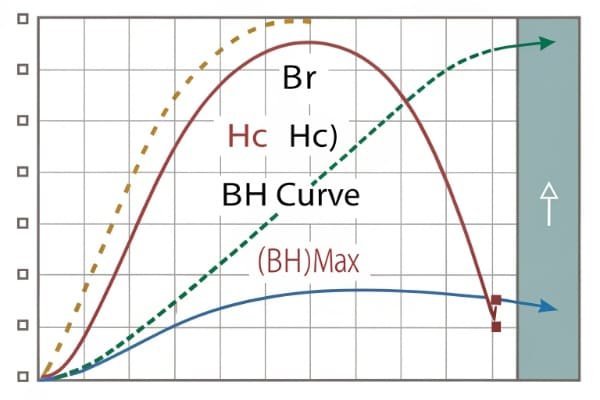
In my experience, this is the most critical engineering decision. The letter after the grade number is more important than the number itself when it comes to automotive reliability. A standard N52 magnet has incredible strength at room temperature, but its performance drops dramatically as it gets hot. An N48SH magnet, while having a slightly lower energy product, will outperform the N52 reliably at 150°C because its higher Hcj resists thermal demagnetization.
The key is to select a grade with a sufficient "demagnetization margin9." This means its maximum operating temperature should be significantly higher than the peak temperature it will ever experience in the vehicle. For high-performance components like EV drive motors or under-hood sensors, this often means looking at EH or even AH grades, which can operate reliably at 200°C and above. While these grades use more costly heavy rare earth elements like Dysprosium and Terbium, this investment is essential for product safety and longevity.
| Application Area | Typical Max Temp. | Recommended Grade Series | Key Consideration |
|---|---|---|---|
| Interior (e.g., Speakers, Switches) | ~85°C | N, M | Cost-effectiveness is key, but M grade offers a better margin. |
| EPS / Transmission | ~120°C - 150°C | H, SH | Balance of performance and cost, requires good thermal stability. |
| Under-Hood (e.g., Sensors) | ~150°C - 180°C | SH, UH | High reliability needed in a harsh thermal environment. |
| EV Traction Motor | ~180°C - 220°C | EH, AH (TH) | Maximum thermal stability is critical for performance and safety. |
Which Coating Prevents Corrosion from Road Salt and Humidity?
Are you seeing rust on magnets returned from field tests? A standard nickel or zinc coating might look good initially but will fail quickly when exposed to road salt, engine fluids, and constant humidity.
For under-hood and other exposed automotive components, you must specify a multi-layer coating system10 like Epoxy or Parylene over a nickel base coat. This system must be validated with extended salt spray testing11 (NSS ≥200 hours) and humidity testing12 (85/85 ≥168 hours).
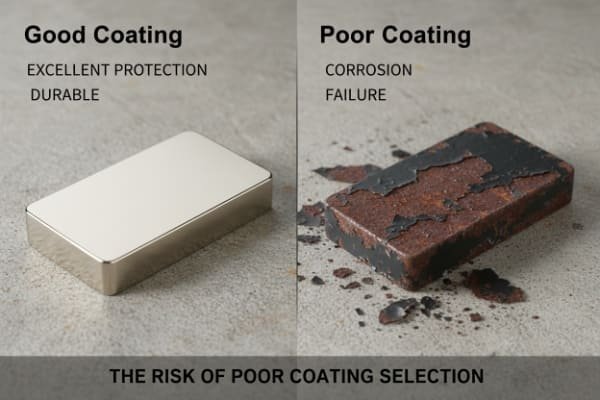
NdFeB magnets are inherently susceptible to corrosion because they contain iron. A simple coating is not enough for the harsh reality of an automotive environment. I always tell my clients that a salt spray test alone is misleading. Real-world failure often comes from a combination of humidity, temperature cycling, and corrosive agents. Therefore, your validation plan must include combined testing.
An Epoxy coating13 provides an excellent chemical-resistant barrier, making it ideal for parts that may be exposed to oils or cleaning agents. For the ultimate protection, especially on complex shapes or where a very thin, uniform layer is needed, Parylene is the superior choice, though it comes at a higher cost. The key is to define your requirements clearly in the engineering drawing and purchase order. Specify not just the coating type, but the minimum thickness, edge coverage requirements, and the pass/fail criteria for your reliability tests.
| Coating System | Recommended NSS Hours | Recommended 85/85 Test | Typical Automotive Use |
|---|---|---|---|
| Ni-Cu-Ni | 24-72 hours | Not specified | Interior cabin components, non-critical applications. |
| Epoxy (over Ni-Cu-Ni) | >200 hours | >168 hours | Sensors, actuators, under-hood components, high-humidity zones. |
| Parylene (over Ni-Cu-Ni) | >200 hours | >500 hours | Mission-critical sensors, harsh environments, complex shapes. |
| Everlube | >1,000 hours | >1,000 hours | Extreme performance applications requiring chemical and heat resistance. |
How Do You Guarantee Supplier Quality and Avoid Fake Certificates?
Have you been burned by a supplier whose parts look great in the sample stage but fail during mass production? This inconsistency can shut down your assembly line and is a clear sign of a weak quality system7.
To avoid this, you must exclusively partner with suppliers certified to the IATF 16949 automotive standard . Furthermore, you must demand a full Production Part Approval Process (PPAP)14 submission for any new part, which provides objective evidence that their process is stable and capable.

From a buyer's perspective, IATF 16949 is non-negotiable. It's much more than a simple quality certificate; it is a rigorous process-oriented standard that ensures a supplier has control over their entire manufacturing system, from raw materials to final packaging. A supplier with this certification has demonstrated their commitment to the quality and consistency that the automotive industry requires.
However, the certificate alone is not enough. The PPAP is your proof. It is a comprehensive package of documents that validates a supplier's manufacturing process for your specific part. Don't just accept a simple test report. A full PPAP submission should include, at a minimum, a Process Flow Diagram, a Process FMEA (Failure Mode and Effects Analysis), a Control Plan, and Measurement System Analysis (MSA). This documentation, along with batch-specific test data for every shipment, is your best defense against quality fade and certificate fraud. At MagniPro, we live by these standards because we know that is the only way to build the trust required for a long-term automotive partnership.
Conclusion
Selecting automotive NdFeB magnets requires a focus on high-temperature grades2, robust coatings, and suppliers with IATF 16949 certification. Demanding a full PPAP ensures reliability and protects your production and brand.
Understanding the challenges can help you make informed decisions when selecting magnets for automotive use. ↩
Learn about high-temperature grades to ensure your magnets perform reliably in extreme conditions. ↩
Coercivity is crucial for magnet performance; explore its significance in automotive applications. ↩
Discover the best coating systems to protect your magnets from harsh automotive environments. ↩
Learn about Parylene's unique properties that make it ideal for protecting sensitive components. ↩
Learn about PPAP documentation to ensure quality and reliability in your automotive parts. ↩
Explore the elements of a strong quality system to avoid issues with suppliers and parts. ↩
Understanding Hcj is essential for selecting magnets that won't demagnetize in high temperatures. ↩
Explore the concept of demagnetization margin to ensure your magnets perform under extreme conditions. ↩
Learn about multi-layer coatings to enhance the durability of magnets in automotive applications. ↩
Understanding salt spray testing can help you choose coatings that withstand harsh environments. ↩
Explore humidity testing to ensure your automotive components can withstand moisture exposure. ↩
Discover why Epoxy coating is a popular choice for protecting magnets in automotive applications. ↩
Understanding PPAP can help you ensure the quality and reliability of your automotive parts. ↩