Are you tired of your electronic devices failing due to overheating, noise, or poor performance? You've picked a strong magnet, but your product is still letting customers down, leading to costly returns.
The solution is to match the magnet's type, grade, and coating to the specific component's environment. For electronic devices, temperature stability1 (Hcj), corrosion resistance2, and field uniformity3 are often more critical than just raw magnetic strength4.
I remember a client who developed a new smartphone with a cutting-edge camera. The autofocus (VCM) worked perfectly in the lab. But after launch, they faced a wave of complaints about focus failures. The issue? They used a standard high-strength magnet. When the phone got warm in a user's pocket or car, the magnet's performance degraded, causing the VCM to fail. They overlooked thermal stability, a small detail that led to a massive, expensive recall. This guide is here to help you avoid that kind of disaster. Let's break down how to select magnets for electronics like a seasoned engineer.
Are You Using the Right Magnet for Smartphone Components?
Is the sound from your smartphone speaker tinny and weak? Does your camera struggle to focus, or does the haptic feedback5 feel sluggish? Your choice of magnet is likely the hidden culprit.
For smartphone speakers, you must balance magnet size with strength to maximize sound pressure. For camera VCMs, high thermal stability (e.g., SH-grade) and field uniformity3 are non-negotiable. For haptic motors, magnet choice directly impacts the response speed that creates a premium feel.
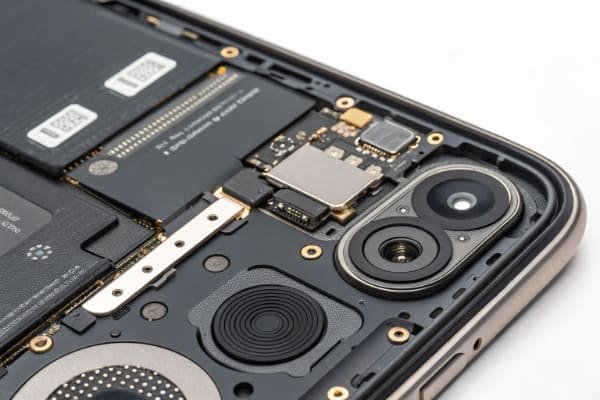
Different components inside a single smartphone have completely different magnetic requirements. Applying a one-size-fits-all approach is a recipe for mediocrity or failure. For example, the magnet in a premium TWS earbud speaker is an engineering marvel of power and miniaturization, while the magnet for a magnetic case closure is all about simple attraction. Understanding these nuances is what separates a world-class product from a generic one. Here's a deeper look at the three key areas in modern smartphones.
Speakers: The Sound Pressure vs. Size Trade-off
In the tiny space of a smartphone or earbud, every millimeter counts. The goal is to produce the loudest, clearest sound possible. The performance of the speaker's magnet has a direct impact on the sound quality. A stronger magnetic field allows the voice coil to move with more force and precision, resulting in better sound. However, a bigger magnet takes up more space. This is where high-performance NdFeB grades shine. By using a higher grade, like a 54SH, you can achieve the necessary magnetic flux6 in a smaller package, meeting the demands of lightweight and slim device designs.
Camera VCM: Stability is King
The Voice Coil Motor (VCM)7 is the tiny engine that moves the lens for autofocus. It requires a stable magnetic field to move the lens with incredible speed and precision. Here, raw strength is secondary to two other factors: thermal stability and field uniformity3. A phone's internal temperature can rise significantly during use. If the magnet's grade is too low (e.g., an 'N' or 'M' grade), it can begin to lose its magnetism, leading to focus failures. For VCMs, specifying a high-temperature grade (SH, UH) is critical.
Vibration Motors: The Feel of Quality
Modern haptic feedback5, delivered by Linear Resonance Actuators (LRAs), is a key part of the user experience. The crisp, instant "click" you feel when typing is thanks to a motor that can start and stop incredibly fast. This response speed is driven by the interaction between the voice coil and the magnet. A consistent, powerful magnetic field allows the LRA to respond instantly to AC power, providing that satisfying tactile feedback that users associate with a high-quality device.
Sintered vs. Bonded: Which is Better for Your Device?
Are you automatically specifying sintered NdFeB8B magnets](https://en.wikipedia.org/wiki/Neodymium_magnet)%%%FOOTNOTE_REF_9%%% for all your designs? This common habit might be costing you money and limiting your design freedom, especially in small, complex consumer electronics10.
Use sintered NdFeB8 for maximum strength where high power is the priority, like in a drone motor. For components with complex shapes11, tight tolerances, and exposure to humidity, bonded NdFeB12 is often the smarter, more cost-effective choice.
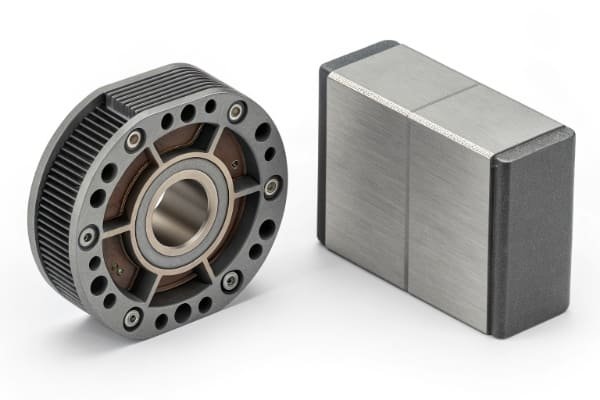
This is one of the most important selection insights for any engineer working on consumer electronics10. Sintered and bonded magnets are both "NdFeB," but their manufacturing processes are completely different, giving them unique strengths and weaknesses. Choosing the wrong one can lead to high costs and manufacturing headaches.
The Powerhouse: Sintered NdFeB
Sintered magnets are made by compressing NdFeB powder at high temperatures to form a solid, dense block, which is then cut and ground to shape.
- Strength: They are the strongest permanent magnets available, with the highest magnetic energy product ((BH)max).
- Best Use: Perfect for applications where you need the maximum magnetic force in a given volume, such as high-performance motors13 or long-distance sensors.
- Limitations: They are brittle like ceramic and difficult to machine into complex shapes11. They are also highly susceptible to corrosion and must always have a protective coating14.
The Precision Specialist: Bonded NdFeB
Bonded magnets are made by mixing NdFeB powder with a polymer binder (like nylon) and then injection molding the mixture into a final shape.
- Precision & Complexity: This process allows for the creation of very complex or tiny shapes with high dimensional accuracy15, directly from the mold.
- Durability: They are less brittle than sintered magnets and have better inherent corrosion resistance2 because the magnetic powder is encapsulated by the polymer binder.
- Best Use: Ideal for components in wearables, sensors, and other compact devices where complex shapes11 and reliability are key.
| Feature | Sintered NdFeB | Bonded NdFeB |
|---|---|---|
| Magnetic Strength | Highest | Medium |
| Shape Complexity | Low (hard to machine) | High (injection molded) |
| Dimensional Accuracy | Good (±0.05mm) | Excellent (as-molded) |
| Corrosion Resistance | Poor (requires coating) | Good (binder protects) |
| Typical Application | High-power motors, Speakers | Wearables, Sensors, Complex parts |
What Kills Magnets and How Do You Prevent It?
Is your product failing in the field after months of perfect operation? These mysterious failures are often caused by a dying magnet, the result of a poor initial specification.
The three most common magnet-related failures are demagnetization16 from heat, noise and vibration17 from inconsistent magnetic fields, and assembly failures18 from physical cracking or corrosion. All are preventable with proper engineering choices.
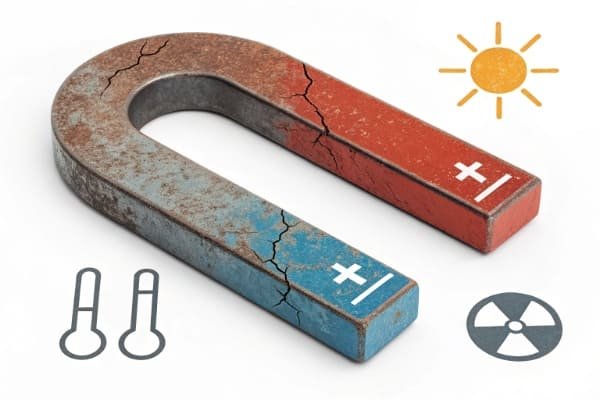
A magnet isn't a simple piece of metal; it's a highly engineered component. Ignoring its physical and thermal limits during the design phase is a direct path to product failure. Understanding these failure modes is the first step toward building a reliable device.
Demagnetization: The Silent Killer
Every magnet has a maximum operating temperature, determined by its grade (the letter suffix, like H, SH, UH). If a magnet is exposed to temperatures beyond this limit, it will begin to permanently lose its magnetic strength4. This is irreversible. For a consumer electronic device that can get hot during charging or be left in a sunny car, choosing a magnet grade with a sufficient temperature margin is not optional; it is essential for long-term reliability.
Noise & Vibration: The Consistency Problem
In motors and acoustic components, a uniform and consistent magnetic field is critical for smooth, quiet operation. If the magnets used from batch to batch are not magnetically identical, performance will vary. One device might be silent, while another buzzes or vibrates. This inconsistency comes from poor quality control during magnet manufacturing. To prevent this, you should specify not just the magnetic strength4, but also the consistency of the magnetic flux6 or waveform, and work with a supplier who can provide this data.
Assembly Failure: Cracks and Corrosion
Sintered NdFeB magnets9 are very strong magnetically, but they are physically brittle and prone to chipping or cracking if handled improperly during assembly. Furthermore, NdFeB magnets9 are very susceptible to corrosion (rusting). Without a proper protective coating14, a magnet exposed to humidity will rust, expand, and can physically break the component it's housed in. Specifying the correct coating (e.g., Nickel, Epoxy) and performing tests like salt spray testing19 are critical for products used in anything but a perfectly dry environment.
Conclusion
Choosing the right magnet is an engineering decision. It requires matching the magnet's material, grade, and coating to the specific thermal, mechanical, and environmental demands of your electronic device.
Stop Guessing and Start Engineering
Don't let a simple component like a magnet compromise the success of your entire product. My job is to help you get this critical decision right. Send me your device type, component details, operating temperature, and drawings. My engineering team and I, backed by our IATF16949-certified facility, will provide a professional recommendation to ensure your product performs with the excellence and reliability your customers demand.
Learn about the significance of temperature stability in magnet performance and how it affects electronic devices. ↩
Discover how corrosion resistance can enhance the longevity and reliability of magnets in electronic devices. ↩
Understand the role of field uniformity in ensuring consistent performance in electronic components. ↩
Understand the measurement of magnetic strength and its implications for device performance. ↩
Explore how haptic feedback technology improves user interaction in modern devices. ↩
Understand the concept of magnetic flux and its significance in the operation of magnets. ↩
Gain insights into the functionality of VCMs and their critical role in autofocus systems. ↩
Learn about the benefits of sintered NdFeB magnets and their applications in high-performance devices. ↩
Explore this resource to understand the unique properties and uses of NdFeB magnets in various applications. ↩
Explore the latest innovations in consumer electronics and how magnet selection plays a crucial role. ↩
Explore the techniques used to create complex shapes in magnets for specialized applications. ↩
Discover the advantages of bonded NdFeB magnets for complex and compact designs. ↩
Gain insights into the characteristics of high-performance motors and their reliance on strong magnets. ↩
Discover the various protective coatings available and their importance in preventing corrosion. ↩
Learn about the importance of dimensional accuracy in ensuring proper fit and function of magnets. ↩
Explore the factors that lead to demagnetization and how to prevent it in electronic devices. ↩
Understand the impact of noise and vibration on device performance and user experience. ↩
Learn about potential assembly failures and how to mitigate risks during the manufacturing process. ↩
Learn about salt spray testing as a method to evaluate corrosion resistance in magnets. ↩