You bought the strongest neodymium magnets1 on the market, but during assembly, they shattered into pieces. Or worse, six months after launch, your customer returns the product because the magnet rusted or lost its strength. These failures destroy your profit margins and your brand's reputation.
Quick answer: The main disadvantages of neodymium (NdFeB) magnets are that they are extremely brittle2 and prone to shattering; highly susceptible to corrosion3 without proper coating; and have low high-temperature limits4 (standard grades fail around 80°C). Furthermore, their strong fields can interfere with electronics or pacemakers, pose severe ingestion hazards, and require strict, expensive magnetic shielding5 for air shipping.
I see procurement managers and engineers hit these roadblocks every single day. They focus entirely on the massive pull force of NdFeB and ignore its physical vulnerabilities. But here is the engineering truth: you don't have to abandon neodymium. You just need to know how to mitigate its weaknesses.
Let us break down the real risks of NdFeB magnets, how to protect your assembly line, navigate shipping compliance6, and know exactly when to choose an alternative material.
The Three Fatal Flaws of NdFeB (And Your Engineering Solutions)
NdFeB is not a solid block of invincible metal. It is manufactured via powder metallurgy, making its physical structure closer to a ceramic teacup than a steel brick. If you treat it like steel, it will fail.
1. Extreme Brittleness and Chipping
When two raw neodymium magnets snap together across a table, the impact force is massive. Because the material lacks flexibility, the magnets will chip or shatter completely, sending sharp, magnetized shrapnel flying.
- The Fix: Never allow raw magnets to snap together. Train your assembly line workers to slide magnets apart. Always use non-magnetic spacers (like plastic or wood) during storage and transit. Design your product housing to absorb mechanical shock before it reaches the magnet.
2. The Rust Problem (Corrosion)
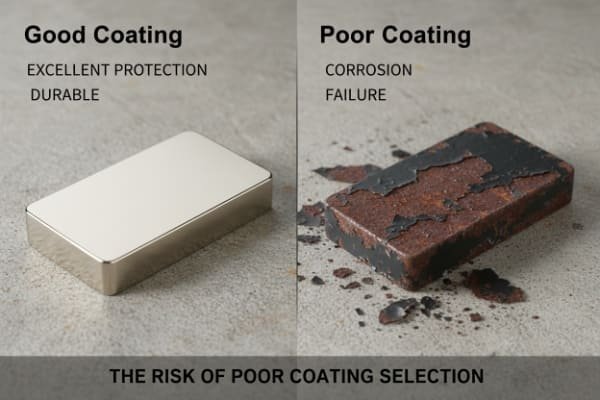
NdFeB contains a high percentage of iron. If exposed to humidity, sweat, or salt, an uncoated neodymium magnet will quickly rust, expand, and crumble into magnetic powder, destroying your device from the inside out.
- The Fix: A standard Nickel-Copper-Nickel (NiCuNi) coating is the bare minimum for indoor use. If your product goes outdoors, touches human skin, or faces a salt-spray environment, you must specify heavy-duty coatings like Black Epoxy or Parylene. For severe marine environments, consider total hermetic encapsulation in a stainless steel shell.
3. High-Temperature Demagnetization
This is the silent killer of motors and electronics. A standard N52 magnet is incredible at room temperature, but if your device heats up to 80°C, the magnet will suffer irreversible strength loss.
- The Fix: If your application generates heat, you must upgrade to a high-coercivity temperature grade. Use suffixes like H, SH, UH, or EH. An N45SH magnet will easily survive 150°C, drastically outperforming a standard N52 in a hot environment.
Safety First: Handling and Operational Risks
The sheer power of NdFeB creates unique safety hazards7 that you must account for in your factory and your user manuals.
- Pinch Hazards: Large neodymium magnets can crush fingers instantly. Workers must wear heavy-duty protective gloves and handle large blocks with extreme caution.
- Electronic and Medical Interference: Keep these magnets far away from magnetic media, credit cards, and most importantly, pacemakers or implanted medical devices. Always include clear warning labels on your final product packaging.
- Child and Pet Safety: If two small magnets are swallowed, they can attract each other across intestinal walls, causing fatal internal injuries. If you manufacture toys or consumer gadgets, the magnets must be permanently locked inside the housing to prevent accidental ingestion.
Shipping Headaches: Air Freight and Compliance
You manufactured the perfect product, but your freight forwarder rejects the shipment at the airport. Why? Because strong magnetic fields interfere with aircraft navigation systems.
Shipping NdFeB magnets by air requires strict compliance with regulations like IATA PI 9028 for international flights, or USPS Packaging Instruction 9B domestically.
How to Stay Compliant
If your package's stray magnetic field exceeds 0.00525 gauss at 15 feet, it is forbidden on an aircraft. If it measures between 0.002 gauss at 7 feet and 0.00525 gauss at 15 feet, it is classified as Class 9 Dangerous Goods.
- The Shielding Solution: You must use magnetic shielding packaging. This involves lining the shipping carton with high-permeability materials, like cold-rolled steel sheets, and arranging the magnets in alternating polarities (N-S-N-S) to cancel out the field.
- The Paperwork: You will need a certified magnetic flux test report from a recognized lab, proper "Magnetized Material" labels, and potentially a Dangerous Goods declaration.
If air freight compliance is too expensive or complex, your best alternative is to ship via sea or ground, where magnetic restrictions are significantly looser.
The Alternative Decision Tree: When to Ditch NdFeB
Sometimes, the best way to handle the disadvantages of NdFeB is to use a completely different material. Stop forcing a square peg into a round hole. Use this matrix to guide your procurement strategy:
| Your Challenge | Why NdFeB Fails Here | The Best Alternative |
|---|---|---|
| Extreme Heat (>200°C) | Even EH/AH grades of NdFeB will eventually degrade or demagnetize. | Samarium Cobalt9 (SmCo). It handles up to 350°C perfectly and has excellent corrosion resistance. |
| Severe Corrosive Environment | Coatings can get scratched, exposing the iron-rich core to rapid rusting. | Ferrite10 (Ceramic) or SmCo. Ferrite is inherently rust-proof (it is already an oxide). |
| Strict Cost Limits & Large Size | Rare-earth pricing fluctuates, making large NdFeB blocks incredibly expensive. | Ferrite. It is the cheapest magnetic material available, perfect for large, low-cost applications. |
| Absolute Maximum Heat (>500°C) | All modern rare-earth magnets will fail. | Alnico11. Older technology, weaker pull force, but survives extreme furnace-level heat. |
Stop Guessing and Let Us Protect Your Project
Understanding the risks is the first step. Engineering the right solution is the second. At MagniPro, we don't just sell you a magnet and walk away.
As an ISO 9001 and IATF 16949 certified manufacturer, we mitigate these disadvantages for you. We provide the precise temperature grades, the exact Epoxy or Parylene coatings for salt-spray resistance, and we engineer the magnetic shielding packaging to ensure your shipment clears aviation customs without a hitch.
Don't let a brittle2, rusty, or non-compliant magnet ruin your business. Submit your project details today—dimensions, operating temperature, environmental risks, and logistics needs—and our engineering team will provide a fail-proof manufacturing and shipping solution within 24 hours.
---Explore the pros and cons of neodymium magnets to make informed decisions for your projects. ↩
Understanding the brittleness of neodymium magnets can help you avoid costly assembly failures. ↩
Learn effective methods to protect neodymium magnets from rust and extend their lifespan. ↩
Discover the temperature thresholds for neodymium magnets to ensure optimal performance in your applications. ↩
Find out how magnetic shielding can protect sensitive electronics from strong magnetic fields. ↩
Stay compliant with shipping regulations to avoid delays and ensure safe transport of your products. ↩
Understanding safety risks can help you implement better safety measures in your workplace. ↩
Learn about IATA PI 902 regulations to ensure your shipments meet international air transport standards. ↩
Discover why Samarium Cobalt magnets are a superior alternative in high-temperature applications. ↩
Learn about Ferrite magnets as a cost-effective alternative for various applications. ↩
Understand the unique properties of Alnico magnets for applications requiring high-temperature resistance. ↩