Are you constantly defaulting to the highest magnet grade to guarantee your product's performance? Buying N52 magnets when you don't need them destroys your profit margins. Even worse, choosing N521 for the wrong environment will cause catastrophic product failures.
Quick answer: For the same size and shape, N52 is stronger than N452 because its maximum energy product (BHmax3) is higher (≈49–53 vs 43–46 MGOe), often yielding about 10–20% more pull force4. But if your application runs hot, a high‑temperature grade like N45H/SH can be more reliable than standard N52.
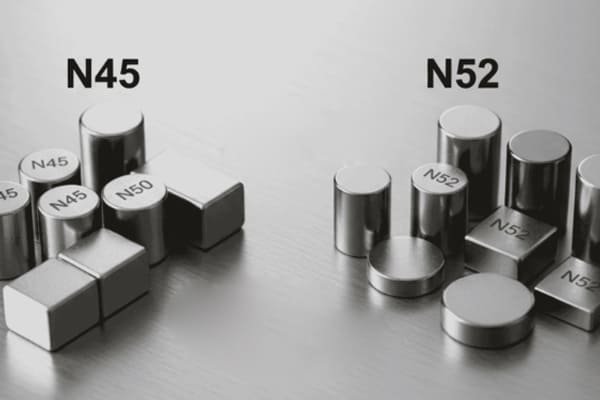
I see this expensive mistake every single day. Procurement managers and engineers look at a datasheet, see that 52 is a higher number than 45, and immediately place the order. They think they are buying "the best." But in the permanent magnet industry, "strongest" does not always mean "most reliable."
Let us break down the real engineering logic behind N45 and N52 magnets so you can stop guessing, reduce your costs, and engineer a fail-proof product.
The Real Difference: What Do N45 and N52 Actually Mean?
If you don't understand the grade nomenclature, you are flying blind. The number in a Neodymium (NdFeB5) magnet grade simply represents its Maximum Energy Product6, measured in MegaGauss-Oersteds (MGOe).
Think of it as the magnet's "energy density." An N52 magnet packs more magnetic energy into the exact same physical volume than an N45 magnet.
- N45: BHmax is typically between 43 and 46 MGOe.
- N52: BHmax is typically between 49 and 53 MGOe.
If you have two magnets of the exact same dimensions (for example, a D10x2mm disc), the N521 will generate a stronger magnetic field and typically provide 10% to 20% more pull force than the N45. If your product is extremely restricted in space—like a micro-sensor or a premium TWS earbud—and you need maximum power, N52 is your winner.
Standard Grade Comparison Table (Room Temperature)
| Grade | Max Energy Product (BHmax) | Relative Pull Force | Cost Level | Best Use Case |
|---|---|---|---|---|
| N45 | 43 - 46 MGOe | Baseline | Medium | Cost-effective general electronics, packaging |
| N52 | 49 - 53 MGOe | +10% to 20% | High | Extreme miniaturization, space-constrained assemblies |
(Note: Data is for reference. Actual pull force heavily depends on geometry and assembly.)
The Temperature Trap: When N45 Destroys N52
Here is where the "highest grade is always best" myth falls apart.
Standard N-grade magnets (without any letters at the end) are only rated to work up to 80°C. If your device gets hot—like an electric motor, a car mount in the summer sun, or a high-wattage wireless charger—a standard N52 magnet will begin to suffer irreversible demagnetization.
This is the silent killer of product performance. You paid top dollar for N52, but at 100°C, it becomes weaker than a cheap ferrite magnet.
This is why you must look at the temperature suffix. The letters after the number (M, H, SH, UH, EH) indicate the magnet's Intrinsic Coercivity7 (Hcj)—its ability to resist heat and demagnetizing fields.
If your application runs at 120°C, a standard N52 will fail. However, an N45H (rated for 120°C) or an N45SH (rated for 150°C) will maintain its magnetic stability perfectly. In high-heat environments, the "weaker" N45H is infinitely superior to the "stronger" N52.
| Magnet Grade | BHmax3 (Power) | Max Operating Temp | Reliability at 120°C |
|---|---|---|---|
| N52 (Standard) | Very High | 80°C | Fails (Irreversible Demagnetization) |
| N45H | High | 120°C | Stable and Reliable |
Geometry and Air Gaps: The True Dictators of Pull Force
"I bought an N52, but it won't hold my cabinet door!" I hear this complaint constantly.
A magnet's grade is only potential energy. How you use it dictates the actual pull force. Two physical factors matter far more than the difference between N45 and N52:
- Magnet Dimensions (Thickness): A thick N45 magnet will easily out-pull a paper-thin N52 magnet. The geometry (Permeance Coefficient) determines how well the magnet projects its field.
- The Air Gap: This is the most brutal enemy of magnetic force. An "air gap" is any non-magnetic material between the magnet and the metal it is sticking to. This includes paint, plastic housing, double-sided tape, or even the magnet's own anti-corrosion coating. Even a 0.5mm air gap8 can slash your pull force by 50%.
If your magnet is hidden behind 2mm of plastic, upgrading from N45 to N52 will not save your design. You must either reduce the air gap, increase the physical size of the magnet, or use a steel backing plate to redirect the magnetic flux.
Clearing the Misinformation: The MRI Myth
Let me clear up a ridiculous myth circulating on the internet. You will see poorly researched articles claiming that "N52 magnets are so strong they are used in hospital MRI machines."
This is completely false.
Medical MRI machines do not use massive N52 NdFeB magnets to generate their primary imaging fields. They use superconducting electromagnets9 cooled by liquid helium, which generate absolute magnetic fields far beyond the physical limits of any permanent magnet.
Do not trust suppliers who use exaggerated claims to sell you expensive materials. Trust engineering facts. NdFeB is the strongest commercial permanent magnet, but it has strict physical boundaries.
The Ultimate N45 vs. N52 Selection Checklist
Stop guessing and use this engineering framework to make your purchasing decision:
- [ ] Space Constraints: If you have zero room to increase the magnet's size but absolutely need more pull force4, choose N52.
- [ ] Cost Control: If you have room to increase the magnet's thickness by just 1mm, a larger N45 will give you the same force as a smaller N52, usually at a lower cost.
- [ ] Operating Temperature: If your product exceeds 80°C, abandon standard N52 immediately. Specify high-coercivity grades like N45H, N45SH, or N45UH.
- [ ] Corrosion Environment: Neither N45 nor N52 survives moisture without a coating. For indoor electronics, NiCuNi is fine. For sweat, salt spray, or outdoor environments, specify Epoxy or Parylene coatings.
Stop Wasting Money on the Wrong Magnet
At MagniPro, we do not just sell you the most expensive grade on the catalog. We engineer solutions that protect your product's reliability and your company's bottom line.
Let us do the heavy lifting for you. Send us your requirements using the checklist below, and our engineering team will provide a precise grade recommendation and quotation within 24 hours.
Submit your project details:
- Dimensions / Shape: (e.g., D10x2mm Disc)
- Target Pull Force / Torque:
- Max Operating Temperature: (e.g., 100°C)
- Air Gap / Assembly Details: (e.g., 1mm plastic housing)
- Estimated Annual Volume & Lead Time:
[Contact MagniPro Engineering Team Now]
Learn about the benefits of N52 magnets and how they can enhance your product's performance. ↩
Explore this link to understand the N45 magnet grade, its properties, and ideal use cases for your projects. ↩
Understanding BHmax is crucial for selecting the right magnet for your application. ↩
Find out how pull force is determined and why it matters for your magnet applications. ↩
Explore NdFeB magnets and their role as the strongest commercial permanent magnets. ↩
Discover the significance of Maximum Energy Product in magnet performance and selection. ↩
Learn about Intrinsic Coercivity and its role in magnet performance under varying conditions. ↩
Understand the impact of air gaps on magnet strength and how to mitigate their effects. ↩
Understand the technology behind superconducting electromagnets and their applications. ↩