Are your magnets rusting in the field, causing product failures and damaging your brand's reputation? You specified a salt spray test1, but the results from your supplier don't seem to match reality. This uncertainty puts your entire project at risk.
To ensure magnets pass, specify a clear standard (e.g., ISO 9227 NSS2), duration (e.g., 48 hours), coating (e.g., Ni-Cu-Ni3), and acceptance criteria4 ("no red rust"). Most importantly, demand a detailed test report5 with photos and a Certificate of Analysis (COA)6 for every batch.
Getting this right is more than just a checkbox on a spec sheet. I have seen too many clients lose money because they trusted a simple "SST Passed" statement from a supplier. The details are what protect your investment. A salt spray test isn't just one test; it's a whole process that, if misunderstood, can lead to costly failures. Let's break down exactly what you, as a buyer, need to know to secure your supply chain.
Which Coating Is Right for Your Salt Spray Test Needs?
Choosing the wrong coating is like wearing a paper coat in a rainstorm. It leads to premature failure and wasted money, even if it technically "passes" a basic test you didn't specify properly.
For general indoor electronics, a standard Nickel-Copper-Nickel (Ni-Cu-Ni) coating passing 24-72 hours is cost-effective. For high humidity, outdoor use, or skin contact, you must specify a coating like Epoxy or Parylene7, capable of withstanding 200+ hours of testing.
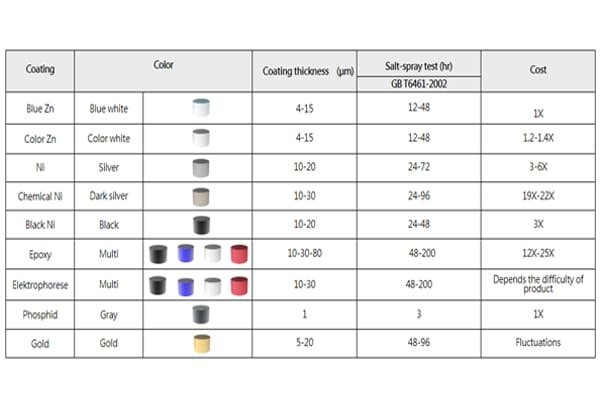
As an engineer or procurement manager, your goal is to match the coating to the product's real-world environment, not just to pass a generic test. A cheap Blue Zinc coating8 might pass a 12-hour test, but it will quickly corrode in a humid bathroom environment. It's about finding the right balance between cost and performance.
I always advise my clients to think about the end-use first. Will the magnet be visible? Will it be touched frequently? Will it be exposed to sweat, salt water, or high temperatures? The answers to these questions will guide your choice far better than price alone. For example, while Ni-Cu-Ni is a fantastic all-arounder, an Epoxy coating provides superior adhesion for gluing and better resistance in consistently damp conditions.
Here’s a practical guide to help you decide:
| Coating Type | Typical NSS Hours | Cost Index (Approx.) | Best Use Case |
|---|---|---|---|
| Zinc (Zn) | 12 - 48 hours | 1x | Dry, indoor applications where cost is the main driver. |
| Nickel (Ni-Cu-Ni) | 24 - 72 hours | 3-6x | General purpose, consumer electronics, good appearance. |
| Epoxy (Black/Gray) | 48 - 200+ hours | 12-25x | Humid environments, marine applications9, motors, where adhesion is key. |
| Parylene | > 72 hours | High | Medical devices, applications with direct sweat contact, extreme corrosion resistance10. |
How Do You Specify a Salt Spray Test in Your Purchase Order?
Leaving a vague "salt spray test required" on your Purchase Order (PO) is an open invitation for problems. This ambiguity leads to disputes, quality fade, and receiving batches that fail in the field.
In your PO, you must explicitly state the test standard (e.g., ISO 9227), test type (e.g., Neutral Salt Spray - NSS), parameters (5% NaCl solution, 35°C), duration (e.g., 96 hours), and the exact acceptance criteria4 (e.g., "no red rust on significant surfaces").
From my experience, clarity in the PO is your single most powerful tool to prevent quality issues. Don't assume your supplier knows what you want. You need to spell it out in a way that leaves no room for interpretation. A professional supplier will appreciate this clarity because it protects both parties.
Here's a breakdown of what to include in your technical specifications:
- Test Standard: Be specific. ISO 9227 is a common international standard for Neutral Salt Spray (NSS) testing. ASTM B117 is also widely used. Don't just say "SST"; specify the exact standard.
- Test Duration: How many hours? This depends entirely on your application. A simple indoor electronic might need 24 hours. A part for an automotive or marine application might require 200 hours or more.
- Acceptance Criteria: This is critical. What does "pass" mean? I always recommend "No red rust visible on significant surfaces after [XX] hours." You can also specify the rating according to standards like ISO 10289. Be clear about whether minor staining or white rust (on Zinc coatings) is acceptable.
- Sample Plan: Specify how many samples from the batch should be tested. This is often defined by an AQL (Acceptable Quality Limit)11 standard like ISO 2859.
Here is a sample clause you can adapt for your PO:
Salt Spray Test Requirement: All parts must be tested according to ISO 9227 Neutral Salt Spray (NSS) standard for a continuous duration of 96 hours. Test parameters: 5% (±1%) NaCl solution, pH 6.5-7.2, temperature 35°C (±2°C). Acceptance Criteria: After 96 hours, samples must show no evidence of red rust when viewed with the naked eye. Supplier must provide a complete test report, including before/after photos of the samples, with the shipment.
Is a Salt Spray Test Enough to Guarantee Real-World Durability?
Your magnets passed the salt spray test, but they are still failing from heat and humidity in the customer's hands. Relying on a single test often gives you a false sense of security and can be a costly mistake.
No, a salt spray test (SST) alone is not enough. It only simulates corrosion from salt fog. For comprehensive reliability, you must combine it with other environmental tests12 like the "85/85" Humidity Test (85°C, 85% RH) and PCT (Pressure Cooker Test) to simulate real-world thermal and humidity stress.

I always push my clients to think about the total environment their product will face. A magnet in a car dashboard will experience extreme temperature cycles. A magnet in a wearable device will be exposed to sweat and humidity. A salt spray test tells you nothing about how the coating will perform under these other stresses. This is where many procurement professionals get it wrong; they focus on one test instead of a reliability plan.
True product reliability comes from a combination of tests that simulate the product's entire life cycle.
Here is a quick guide to building a better test plan:
| Application | Recommended Tests | Why It's Necessary |
|---|---|---|
| Indoor Consumer Electronics | SST (24-48h), Adhesion Test (Cross-hatch) | Ensures basic corrosion resistance10 and that the coating won't peel off from normal handling. |
| Automotive Interior | SST (96h+), Thermal Shock (-40°C to 120°C), 85/85 Humidity Test | Simulates a car's harsh environment of temperature swings and condensation, preventing coating cracks and demagnetization. |
| Marine / Outdoor | SST (200h+), PCT (Pressure Cooker Test), UV Exposure Test | Simulates constant exposure to salt, high humidity, high pressure, and sunlight to prevent catastrophic failure. |
| Medical / Wearables | SST (72h+), Artificial Sweat Test, PCT | Ensures the coating can withstand body chemistry and high humidity without corroding or causing skin irritation. |
By specifying a suite of tests, you are moving from simply buying a part to engineering a reliable product. This is how you differentiate yourself and build a brand that customers trust.
How Do You Verify Test Results and Avoid Certificate Fraud?
You received a test report, but how do you know it's real and applies to your specific batch? Certificate fraud is a painful and real risk that can lead to product failures and legal liability.
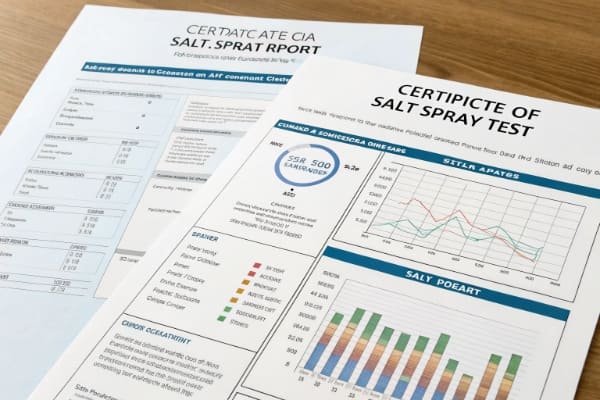
Never accept just a supplier's declaration. For every critical batch, demand a detailed, unalterable test report from the supplier's certified in-house lab or a third-party lab. The report must include test parameters13, before-and-after photos of your parts, and the corresponding batch number for traceability.
This is a point where I am very firm with my clients. Trust, but verify. A trustworthy supplier will have no problem providing this documentation. In fact, they should provide it proactively. A supplier who is hesitant or provides a generic, undated report is a major red flag.
Here’s your verification checklist to avoid getting cheated:
- Demand Batch-Specific Reports: A generic report from six months ago is useless. The report must be tied directly to the production lot you are receiving.
- Check the Report Details: A valid report should contain:
- Clear photos of the actual samples before and after the test.
- The exact standard used (e.g., ISO 9227 NSS2).
- The test duration14, temperature, and other parameters.
- The date of the test.
- A clear pass/fail conclusion based on the criteria you set in your PO.
- Look for a Certificate of Analysis (COA): For critical applications, a COA links the test results to the raw material batch, providing full traceability from raw materials to finished product.
- Partner with Certified Suppliers: Suppliers certified to standards like ISO 9001, and especially IATF 16949 for automotive, have robust quality management systems15 in place. This dramatically reduces the risk of both intentional fraud and unintentional errors.
At MagniPro, providing this level of documentation is standard procedure. It is how we build long-term partnerships based on trust and consistent quality, protecting your business and your reputation.
Conclusion
Mastering the salt spray test is about clear specifications, smart coating choices, comprehensive testing, and demanding proof. This engineering-focused approach is how you de-risk procurement and guarantee long-term magnet reliability.
Understanding the salt spray test is crucial for ensuring your magnets meet corrosion resistance standards. ↩
Learn about the ISO 9227 NSS standard to ensure your products meet international corrosion testing requirements. ↩
Discover why Ni-Cu-Ni is a popular choice for magnet coatings and its advantages in various applications. ↩
Familiarize yourself with acceptance criteria to ensure your products meet quality standards. ↩
Understanding test reports is vital for verifying product quality and compliance with specifications. ↩
A COA is essential for traceability and quality assurance; find out how it protects your investment. ↩
Learn about Parylene's unique properties and its applications in extreme environments. ↩
Discover the drawbacks of Zinc coatings and when they may not be suitable for your applications. ↩
Explore the best coatings for marine environments to prevent corrosion and ensure product longevity. ↩
Understanding the factors influencing corrosion resistance can help you choose the right coating for your needs. ↩
Learn about AQL standards to ensure your products meet acceptable quality levels during testing. ↩
Explore various environmental tests to ensure comprehensive reliability for your magnet applications. ↩
Knowing the test parameters is essential for accurate and reliable salt spray testing. ↩
Understanding the impact of test duration can help you set realistic expectations for product performance. ↩
Learn how robust quality management systems can enhance supplier reliability and product quality. ↩