Choosing a powerful magnet grade that fails in your final product is a costly nightmare. This misstep leads to frustrating redesigns, missed market windows, and eroded profits.
Yes, you can avoid this. To choose the right NdFeB magnet grade1, prioritize the temperature rating2 (e.g., M, H, SH) based on your application's peak operating temperature, not just the magnetic strength3 (the 'N' number). A lower-strength, higher-temperature grade often outperforms a stronger, lower-temp grade in real-world applications.
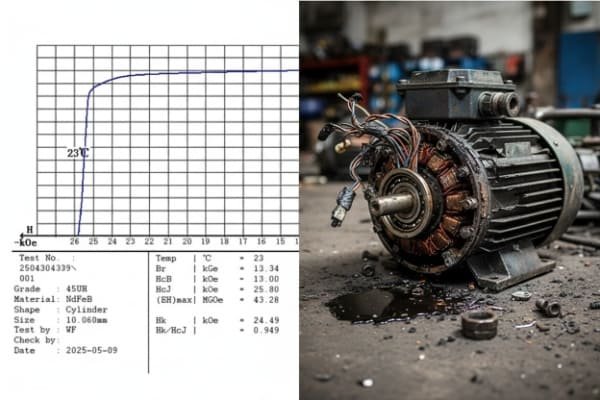
I've seen it happen too many times. An engineer, focused on getting the highest power in the smallest space, picks a strong N52 magnet4. On paper, it's perfect. But once it's inside a motor that heats up or a wireless charger used on a hot day, its performance drops off a cliff. This is the silent killer of product performance.
The problem isn't the quality of the magnet; it's the selection process. A magnet isn't a standalone part; it's a component in a complex system. My clients, from assertive procurement managers like Charalampos in Cyprus to business owners like Reza in Iran, have learned that understanding the application environment is the key to success. Let's move beyond the catalog values and dive into what really matters when choosing a grade.
What Do NdFeB Grade Numbers and Letters Actually Mean?
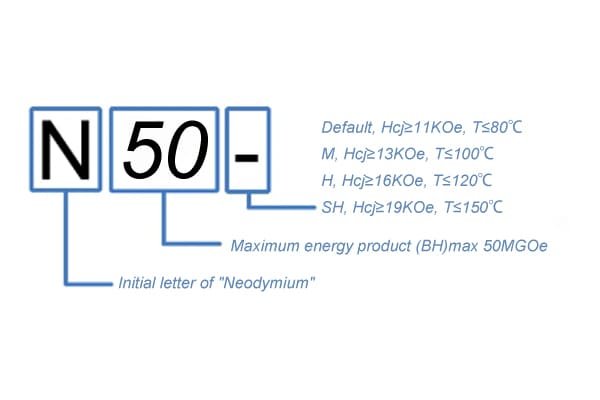
Confused by a magnet grade like "N42SH"? This string of characters seems complex, but it holds the two most critical pieces of information for any engineer or buyer.
The number (e.g., 42) represents the magnet's maximum energy product, a measure of its strength, while the letters (e.g., SH) indicate its maximum operating temperature. The letter code is arguably more important, as it determines the magnet's resistance to demagnetization5 from heat.
Deconstructing the Grade: Strength vs. Stability
Understanding the grade is the first step to avoiding costly mistakes. The "N" simply stands for Neodymium [32]. It's the number and the following letters that you need to focus on.
- The Number (Energy Product): This value, from around 28 to 58, indicates the magnet's strength in MegaGauss-Oersteds (MGOe) [9][32]. A higher number means a stronger magnet. For example, an N52 magnet is stronger than an N42 magnet of the same size.
- The Letters (Temperature Rating): This code signifies the magnet's Intrinsic Coercivity6 (Hcj), which is its ability to resist demagnetization5 from heat [43]. This is the most underestimated parameter.
| Temperature Code | Max. Operating Temp. (Approx.) | Intrinsic Coercivity6 (Hcj) |
|---|---|---|
| (N) | 80°C (176°F) | Standard |
| M | 100°C (212°F) | High |
| H | 120°C (248°F) | High |
| SH | 150°C (302°F) | Super High |
| UH | 180°C (356°F) | Ultra High |
| EH | 200°C (392°F) | Extra High |
| AH/TH | 220°C-230°C (428°F-446°F) | Top High |
Insight: Don't confuse Operating Temperature with Curie Temperature7 (Tc). A magnet will suffer irreversible performance loss long before it reaches its Curie Temperature [48]. The grade's temperature rating2 is the realistic limit you must design for. Learn more about the science on our Temperature vs. Magnet Strength page.
How Do You Select the Right Grade for High-Performance Motors?
Is your high-performance motor losing torque and efficiency as it heats up? This common failure mode isn't a defect; it's a sign that the magnet grade was chosen based on strength, not thermal stability.
For motors, select the grade based on its Intrinsic Coercivity6 (Hcj) first, not its strength (Br). Motor efficiency is limited by magnetic stability at peak temperature. Choose a high-temperature grade (H, SH, UH) that provides a safety margin well above the motor's worst-case operating temperature.
Engineering for Stability, Not Just Strength
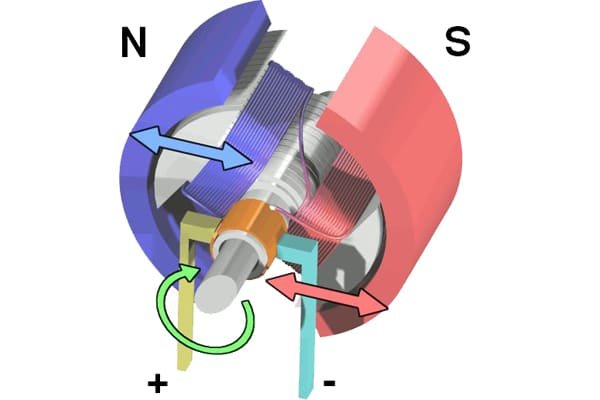
In a motor, high-temperature demagnetization5 is the silent killer of performance. A common mistake is choosing a powerful N52 magnet (80°C rating) for a motor that can spike to 100°C. While stronger at room temperature, the N52 will permanently lose strength once it exceeds its thermal limit.
A better choice would be an N42SH magnet. Although its Br is lower than an N52, its "SH" rating means it remains stable up to 150°C, ensuring reliable performance even during peak loads. This is a critical trade-off that experienced engineers understand. Furthermore, rotor design success depends on magnet tolerance consistency, not just catalog averages. At MagniPro, we provide magnets with tight dimensional tolerances8 to ensure uniform magnetic flux for smoother, more efficient motor operation [18].
- Submit your motor's peak temperature and dimensions — get a grade recommendation9 in 24h.
What's the Secret to Reliable Wireless Charging Magnets?
Is your wireless charger failing due to weak magnetic grip or overheating? This poor user experience often stems from overlooking small details in the magnet system design, not just the power input.
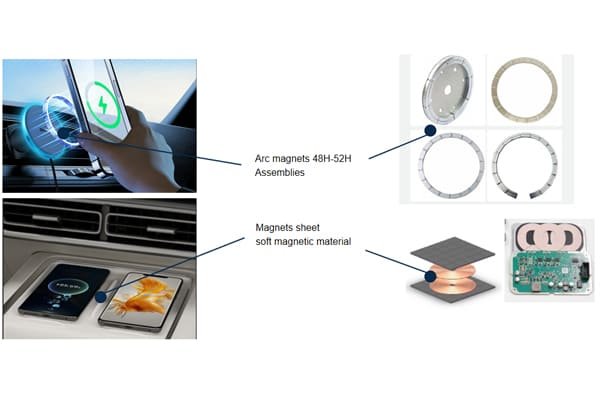
Reliable wireless charging10 performance depends more on precise magnetic alignment and coating integrity than raw power. Use a high-temperature grade (like M or H) to withstand heat, specify a robust coating like Ni+Epoxy to prevent corrosion from humidity, and maintain tight assembly tolerances.
A System Approach to Charging Performance
For consumer electronics, long-term reliability is paramount. A magnet is a key component, and its failure can ruin the entire product [1]. Here's how we address it:
- Heat Resistance: Charging generates heat. We advise a grade like N45M or N42H to provide a thermal safety margin, preventing demagnetization5 and ensuring a consistent magnetic hold over the product's lifetime.
- Alignment is Critical: Small dimensional deviations in the magnet or assembly can cause large losses in charging efficiency and create hot spots. We work with clients to define precise tolerances that ensure perfect alignment between the device and charger.
- Coating for Reliability: Consumer devices are exposed to humidity and handling. The magnet's coating is its only defense against corrosion [6][15]. A standard zinc or nickel coating might not be enough. For superior protection in harsh environments, a multi-layer coating from our Coating Selection Guide is essential.
- Submit your application environment and dimensions — get a grade recommendation9 in 24h.
Why Do Magnets in Industrial Settings Fail So Often?
Is your magnetic separator or sensor failing prematurely from rust or impact? In an industrial setting, this isn't just a part failure; it's unplanned downtime, which costs far more than the magnet itself.
Industrial magnet failure11 is usually a system-level issue, not a material defect. Harsh environments demand robust coating strategies, not just higher grades. For maximum reliability, consider inherently corrosion-resistant materials like Ferrite or SmCo, or fully encapsulate the NdFeB magnet.
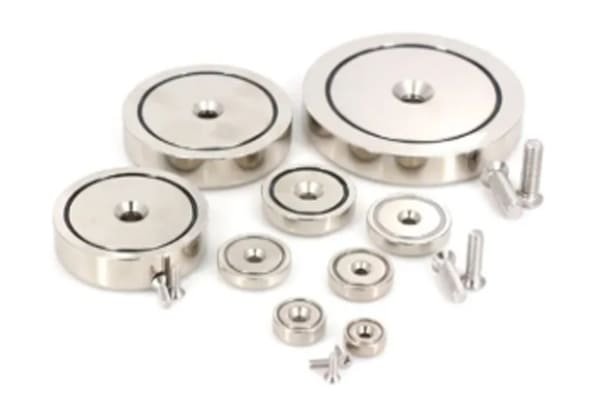
Designing for Downtime Prevention
Downtime costs far exceed the price difference between magnet suppliers. Reliability is the primary goal. While NdFeB is the strongest magnet, it is also highly susceptible to corrosion and is brittle like a ceramic [6].
For industrial applications, the selection process should be:
- Assess the Environment: Is there moisture, salt spray, or chemical exposure? If so, a standard NdFeB magnet, even with a good coating, is a risk.
- Consider Alternatives: For many industrial uses, a Ferrite magnet is a better choice. It's far cheaper and virtually immune to corrosion. For high-temperature and high-corrosion environments, Samarium Cobalt12 (SmCo) is the superior, albeit more expensive, option. Check our Magnet Materials Comparison to see the tradeoffs.
- Encapsulate if Necessary: If you absolutely need the strength of NdFeB, it must be protected. We recommend designing a full stainless steel or plastic encapsulation to seal the magnet from the harsh environment.
- Submit your operating environment and lifetime requirements — get a grade recommendation9 in 24h.
How Can You Guarantee Grade Performance and Avoid Mistakes?
Have you ever received magnets that don't perform as promised on the datasheet? This happens when a supplier lacks rigorous engineering validation13 and quality control14, leading to costly failures in your product.
True grade performance is ensured through comprehensive testing that simulates real-world conditions. This includes magnetic property testing15 to confirm Br and Hcj, thermal cycling tests16 to validate temperature stability, and salt spray tests17 to verify coating integrity. Relying on a supplier with robust, certified quality systems is essential.

Our Commitment to Quality: Beyond the Datasheet
At MagniPro, we believe that repeatability is more important than one-time performance. Our clients trust us because we don't just sell magnets; we engineer and validate them [1][51]. Our quality management is built on a foundation of rigorous testing and certified processes.
- Magnetic Performance Testing: We verify that every batch meets the specified grade for critical parameters like Br and Hcj [2][52].
- Thermal Performance & Shock Tests: We subject magnets to extreme temperature shifts to ensure they maintain their stability, preventing the "silent killer" of high-temperature demagnetization5 [3][52].
- Corrosion & Coating Tests: Our salt spray testing assesses the longevity of coatings, guaranteeing that your magnets will survive their intended environment [2][52].
This commitment is backed by our ISO 9001, ISO 14001, and IATF16949 certifications, providing you with the assurance that you are receiving a product engineered for reliability [1][51].
Conclusion
Choosing the right NdFeB grade is not about picking the strongest magnet; it's about engineering a solution. Match the grade's thermal stability to your application's environment to avoid costly failures.
Take the Guesswork Out of Grade Selection
| Resource | Description | Call to Action |
|---|---|---|
| Full NdFeB grade Pack | A comprehensive collection of datasheets for all standard NdFeB magnet grade1s, including detailed magnetic and physical properties. | Download Grade Pack (PDF) |
Explore this resource to understand how to select the right NdFeB magnet grade for your specific needs. ↩
Learn about the importance of temperature ratings in magnet selection to avoid costly failures. ↩
Discover the key factors that determine magnetic strength and how to choose the right magnet. ↩
Find out where N52 magnets are best utilized and their limitations in high-temperature environments. ↩
Learn about the factors leading to demagnetization and how to prevent it in your applications. ↩
Understand the significance of Intrinsic Coercivity in selecting magnets for various applications. ↩
Explore the concept of Curie Temperature and its impact on magnet performance in real-world scenarios. ↩
Understand how precise dimensional tolerances can enhance the performance of magnet assemblies. ↩
Find out how to obtain expert recommendations for selecting the right magnet grade. ↩
Discover best practices for ensuring reliable wireless charging performance with the right magnets. ↩
Understand the reasons behind magnet failures in industrial applications to improve reliability. ↩
Learn about the unique properties of Samarium Cobalt magnets and their applications. ↩
Learn about the role of engineering validation in ensuring the reliability of magnets. ↩
Discover the importance of quality control in ensuring the performance of magnets. ↩
Get insights into the processes involved in testing the magnetic properties of magnets. ↩
Learn about thermal cycling tests and their role in validating magnet performance. ↩
Explore the significance of salt spray tests in assessing magnet durability in harsh environments. ↩